

Read time: 5 minutes | Forward to a friend
A few years ago, I watched a talented colleague get laid off. She was brilliant at her job, but when she started looking, almost nobody in her industry knew her name. Meanwhile, another colleague who'd been casually commenting on LinkedIn posts for months? He had three conversations with hiring managers within a week... Same talent. Wildly different outcomes. When did we decide that being great at your job was enough to keep your career safe?
Here's the trap most professionals fall into: they hear "you need to be on LinkedIn" and immediately picture the influencer path:
Posting every day...
Chasing likes...
Building a personal brand that feels more like a second job than a career strategy...
So they do nothing instead.
And that's the real danger — not that you'll become some cringey content creator, but that you'll stay completely invisible to the people who matter most for your next opportunity. In a market where layoffs happen without warning and hiring managers increasingly source candidates through their networks, being unknown is a professional liability. It's not a matter of modesty, it's a matter of fragility. If nobody outside your current company knows what you do or how well you do it, your entire career sits on a single point of failure: your current employer's decision to keep you.
Let's reframe what LinkedIn actually is for professionals building independence. It's not a content platform. It's a visibility tool. And there's an enormous difference between being an influencer and being strategically visible.
"70% of LinkedIn Profiles have less that 1000 followers"
Identify the dependency: Most professionals have zero professional visibility outside their current company. Their reputation, network, and recognition are all locked inside one organization. That's not humility — that's exposure.
Navigate why this matters: When a layoff hits, a reorg happens, or you simply want to explore something new, strategic visibility is what creates options. It's the difference between scrambling to "network" during a crisis and already being known by the people who can help.
Develop the approach — Strategic Visibility vs. Influencer Mindset:
The influencer mindset says you need to create content regularly, build a massive following, chase viral moments, and become a thought leader. That's one path, and it's not for everyone.
The strategic visibility mindset is different. It just asks: Do the right hiring managers know I exist? Do people in my field recognize my name? Can recruiters find me when relevant opportunities come up?
One path requires becoming a content creator. The other just requires showing up consistently in small ways. And when 70% of LinkedIn Profiles have less that 1000 followers, it doesn't take a lot of effort to stand out.
Execute — here's what strategic visibility actually looks like:
First, comment thoughtfully on three industry posts per week. Not "Great post!" — add a perspective, share a related experience, ask a genuine question. This alone puts your name in front of the right people more than most professionals manage in a year.
Second, send connection requests to people in roles similar to yours at companies you'd consider working for. A short, genuine note goes a long way. You're not asking for a job. You're building a network before you need one.
Third, share an occasional insight from your work experience — even if it's just a thoughtful comment on someone else's post. You don't need to write a 2,000-word article. A few sentences of real perspective stand out more than most polished content.
Fourth, congratulate connections on promotions, job changes, and milestones. It takes ten seconds. It keeps relationships warm. And it keeps your name showing up in the right places.
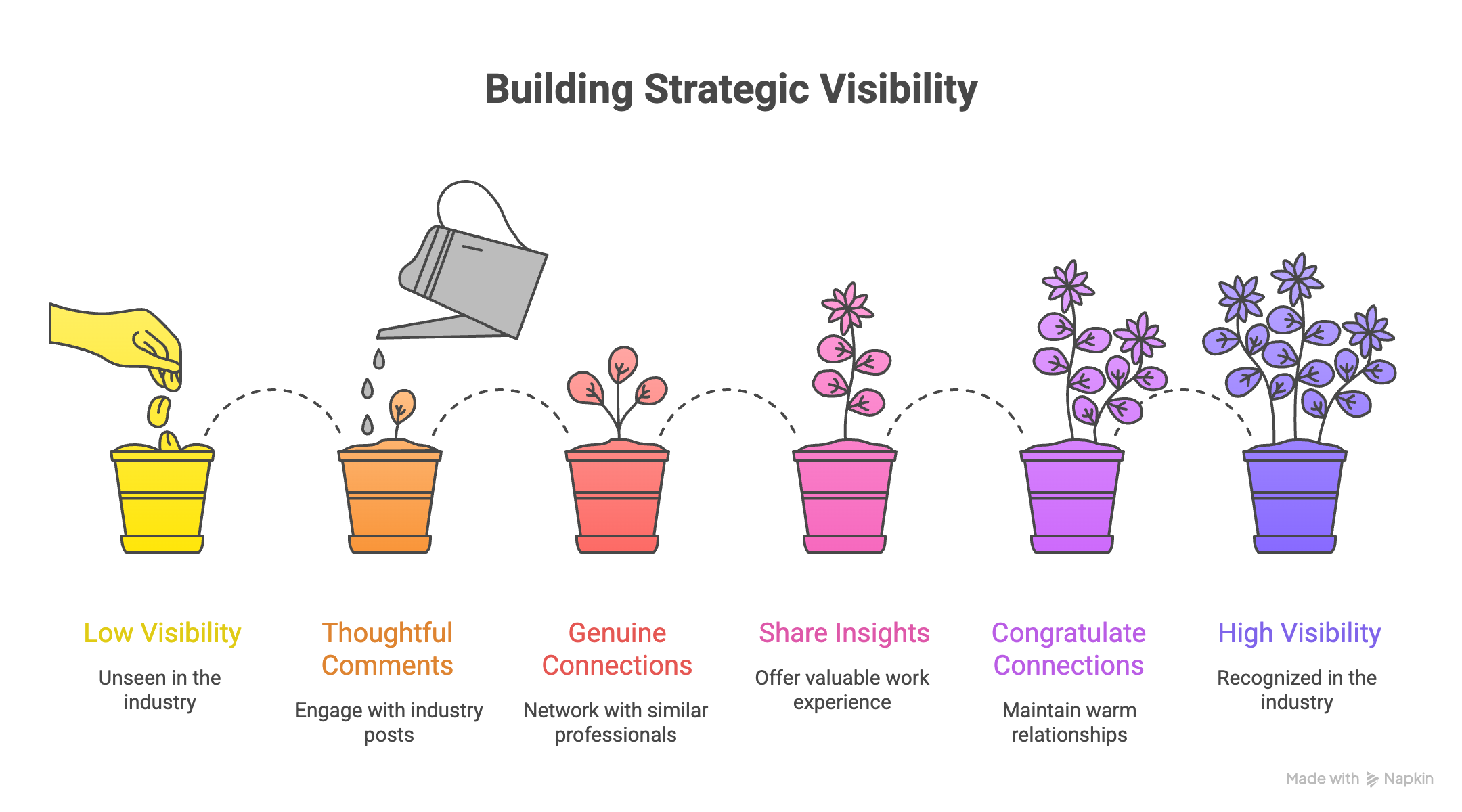
That's it. No viral content required. No personal brand strategy. No posting calendar. Just genuine, low-effort engagement with people who matter for your career.
Before I understood professional independence, I treated LinkedIn like an online résumé — something I updated only when I was actively job hunting. During one career transition a few years back, I realized I was starting completely from scratch. Nobody in my target industry knew who I was. I spent months rebuilding connections that I could have been maintaining all along with fifteen minutes a week. That experience taught me something I'll never forget: the time to build visibility is when you don't need it. The professionals who weather career disruptions best aren't the ones with the most followers — they're the ones who were already findable when it mattered.
This Week:
- Comment thoughtfully on 3 posts from leaders or peers in your industry — add a real perspective, not just "Great insight!"
- Send 5 connection requests to people in similar roles at companies you respect, with or without a short personal note
This Month:
- Audit your LinkedIn headline and summary — does it communicate your expertise to someone who's never met you?
- Identify 10 people in your industry whose content you can regularly engage with
Reflection Question: If you were laid off tomorrow, how many people outside your current company would know your name and your work well enough to recommend you?
I recently heard from a reader who started spending just 10 minutes a day engaging on LinkedIn after a layoff scare at their company. Within two months, a former colleague they'd reconnected with reached out about a role that wasn't even posted yet. No content creation. No viral posts. Just consistent, genuine visibility. That's professional independence in action.
When you're ready to build professional independence:
-
Job Market Analyzer GPT — A custom GPT that helps you align your resume and LinkedIn profile with what companies are actually hiring for right now. Access HERE
-
From Invisible to In-Demand — Learn the 4-action system that got me 3-5 recruiter contacts per week, starting with ZERO connections and a brand new LinkedIn profile. Download HERE
- Layoffs: The First 7 Days — The immediate action guide for professionals who just got laid off, because panic won't help, but a plan will. Download HERE
- The At-Risk Professional Self-Assessment — A short (2 minute) assessment designed to help you identify whether your professional life is structurally resilient, or overly dependent on a single system, and "At Risk." Eight simple yes/no questions. Access HERE
Forward this to someone who thinks they need to become an influencer to benefit from LinkedIn. They don't. They just need to be findable.
Nathan Pearce
Creator of The Professional Independence Academy

Responses