

Read time: 5 minutes | Forward to a friend
Your manager just asked you to "temporarily" cover another role.
Three months later, you're still doing it.
No raise. No title change. Just double the work.
That's quiet hiring.
And if you're feeling stuck—like you have to accept it—that feeling isn't paranoia. It's a symptom of something deeper.
What Quiet Hiring Really Is
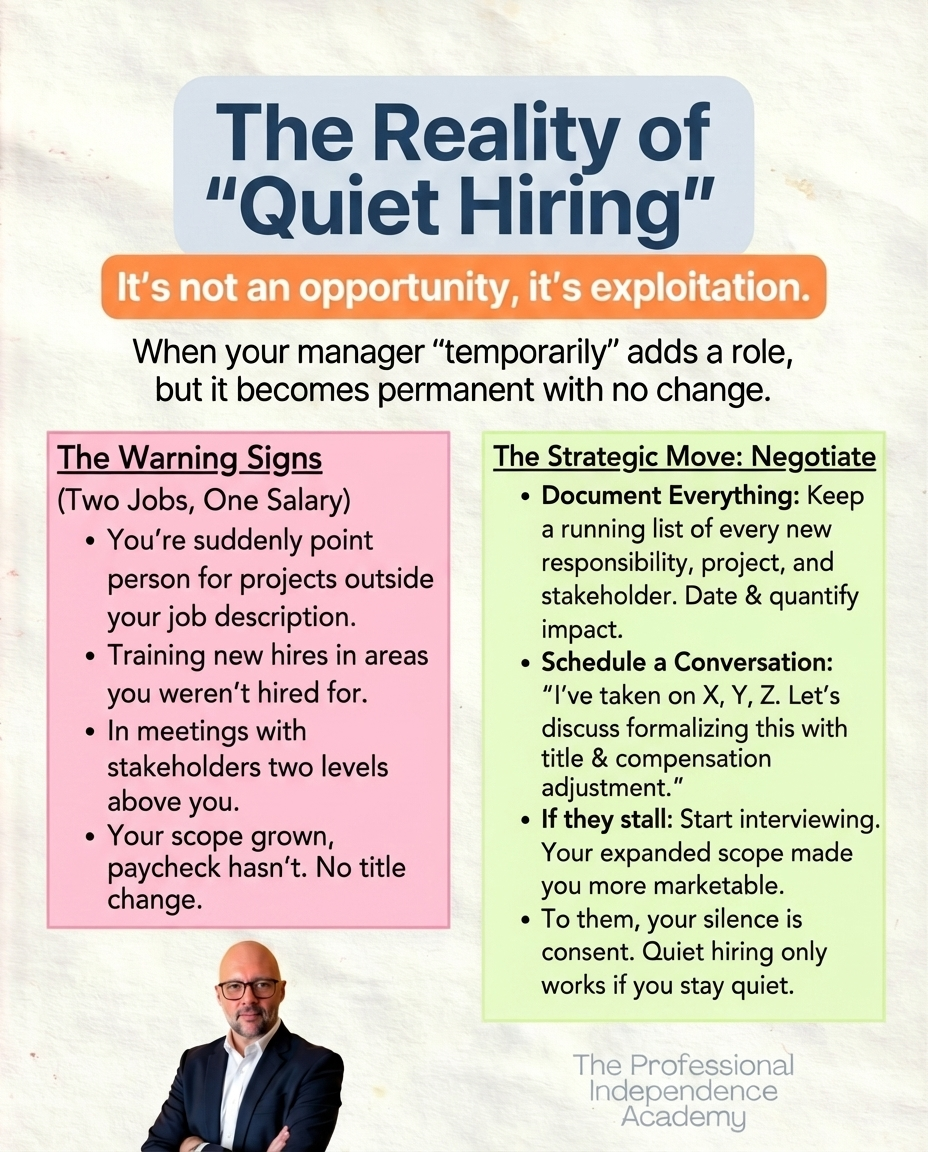
Companies aren't creating new positions anymore. They're quietly expanding yours and hoping you won't notice you're doing two jobs for one salary.
Here's what it looks like:
You're suddenly the point person for projects outside your job description. You're training new hires in areas you weren't hired for. You're in meetings with stakeholders two levels above you. Your scope has grown, but your paycheck hasn't.
This isn't recognition. It's exploitation disguised as opportunity.
But here's what nobody tells you about why this keeps happening to you specifically.
The Real Reason You Can't Push Back
Most career advice will tell you to "document everything" and "schedule a conversation with your manager." And yes, you should do those things. I'll give you that playbook in a minute.
But let's be honest about something first.
The reason quiet hiring works on you is because you have no leverage.
Think about it. When your manager drops extra responsibilities on your desk, what's your actual recourse?
If you push back too hard, you risk being labeled "not a team player." If you threaten to leave, they might call your bluff. If you actually leave, you're starting from zero somewhere else—interviewing, proving yourself, rebuilding relationships.
The company knows this. They're betting that your fear of disruption outweighs your frustration with exploitation.
And for most professionals, they're right.
This is what I call professional fragility—when your entire career, income, and identity are so tied to one employer that you can't afford to rock the boat. You're not negotiating from strength. You're negotiating from desperation disguised as loyalty.
What Leverage Actually Looks Like
Imagine a different scenario.
Same situation: your manager asks you to "temporarily" cover another role. Three months later, nothing's changed.
But this time, you have:
Professional Authority — You've built a reputation in your industry that exists outside your company walls. People know your name. Recruiters reach out regularly. Your LinkedIn presence generates inbound opportunities.
Financial Independence — You have income streams beyond your salary. Maybe it's consulting on the side, maybe it's investments, maybe it's a small business. Either way, losing this job wouldn't be catastrophic.
Strategic Independence — You have a clear career strategy that doesn't depend on this one employer's decisions. You know exactly what you're building toward, and this role is either serving that vision or it isn't.
Now how does that conversation with your manager feel?
You're not asking for permission. You're presenting options.
"I've taken on X, Y, and Z over the past quarter. I'm delivering results in areas outside my original scope. I'd like to discuss how we formalize this with a title change and compensation adjustment—and here's the timeline I'm working with."
If they say "we're working on it" without specifics, you have your answer. And unlike the fragile professional, you can actually act on it.
The Tactical Playbook (For Right Now)
Even if you haven't built your independence yet, here's how to handle quiet hiring today:
Document everything. Keep a running list of every new responsibility, project, and stakeholder relationship you've taken on. Date it. Quantify the impact where you can.
Schedule the conversation. Not to complain. To negotiate. Use this framework:
"I've taken on [specific responsibilities] over the past [timeframe]. I'm delivering results in areas outside my original scope. I'd like to discuss how we formalize this with a title change and compensation adjustment."
Set a deadline (for yourself). If they respond with vague promises and no timeline, that's your signal. Give them 30 days. If nothing changes, start interviewing.
Reframe your leverage. Here's the thing most people miss: your expanded scope just made you more marketable than you were three months ago. You now have experience in multiple areas, cross-functional relationships, and demonstrated ability to operate above your level. That's ammunition for your next role.
The Strategic Playbook (For Your Future)
The tactical moves above will help you survive quiet hiring. But they won't prevent it from happening again at your next company. And your next one after that.
The only way to permanently change the dynamic is to build the kind of professional independence that makes you impossible to exploit.
Start building Professional Authority. Your expertise needs to be visible outside your company. That means creating content, speaking at events, building relationships in your industry—anything that makes your reputation portable.
Start building Financial Independence. Even small steps matter. A side consulting project. An investment strategy. Revenue that doesn't depend on your manager's mood or your company's budget.
Start building Strategic Independence. Know what you're building toward. Have a plan that you control. When you have a vision for your career that doesn't require any single employer's permission, you negotiate differently.
To them, your silence is consent. Quiet hiring only works if you stay quiet about it.
But the deeper truth? Quiet hiring only traps you if you've built a career with no exit doors.
Start building your doors.
This week's independence-building action: Audit your leverage. Ask yourself honestly: if I pushed back hard on something at work tomorrow, what would actually happen? If the answer makes you uncomfortable, that's not a personality flaw—it's a strategic vulnerability. And it's fixable.

Want To Learn More? Join Us December 17th
Want to dive deeper into layoff readiness strategies? I'm hosting a free Layoff Readiness Webinar on December 17th where we'll cover not just the timing patterns, but the specific steps you can take now to build professional resilience.
Register here: Layoff Readiness Webinar
When You're Ready to Build Professional Independence
- Download The Free 21-page Guide – "Getting a Job: From Invisible to In-demand":
This guide gets you discovered for your next role. But more importantly, it's the first step toward building a career that doesn't collapse every time the market shifts or your company cuts headcount. Download here - Layoff Recovery - The First 7 Days: Our comprehensive guide covering what you need to do in the first 7 days after a layoff: Download here
Forward this to someone who needs to see the pattern before the next layoff season hits.
Nathan Pearce
Creator of The Professional Independence Academy





Responses